
Rosemary (Rosmarinus Officinalis) Leaf Extract
Rosemary for hair: what rosemary extract does, how it's different from rosemary oil and rosemary water, and how to work all three into your routine.

What is rosemary extract?
Rosemary (Rosmarinus officinalis) is the fragrant evergreen herb that has seasoned Mediterranean kitchens for centuries. Its leaves are rich in antioxidant compounds, including rosmarinic acid and carnosic acid. On our labels, rosemary appears as Rosmarinus Officinalis (Rosemary) Leaf Extract.
What rosemary does for hair
Rosemary earns its place as an antioxidant botanical. It helps hair and scalp stand up to environmental stress, supports a clean, refreshed scalp feel, and gives conditioning blends a light botanical character. Texture-wise, it plays well with the oils and waters in your wash-day lineup.
Rosemary extract vs rosemary oil vs rosemary water
Same plant, three formats:
- Rosemary extract is the concentrated botanical we build into formulas. It carries the antioxidant payload.
- Rosemary oil is used for scalp massage and sealing — a few drops warmed between the palms. Rosemary Oil
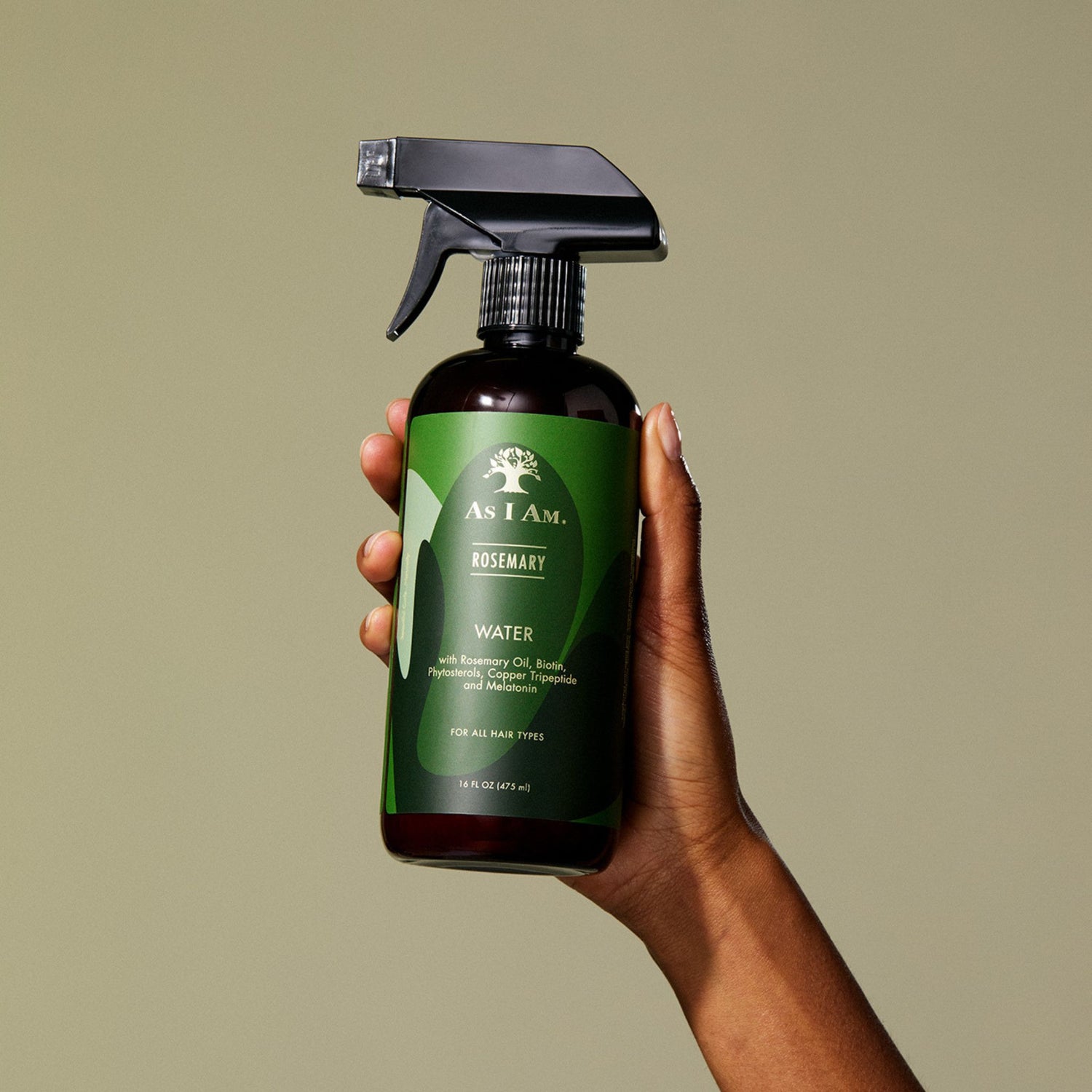
- Rosemary water is a light mist for daily refreshes — braids, locs, edges, post-workout. Rosemary Water
Most routines use more than one.
Why we use rosemary
Rosemary has been part of hair and scalp rituals for generations — from Mediterranean courtyards to Caribbean kitchens. Our founder, Dr. Ali N. Syed, built As I Am on botanicals with that kind of history. Rosemary's antioxidant strength and fresh herbal character made it a natural fit for our scalp and strength routines.
Rosemary benefits for hair
- Antioxidant support: rosmarinic acid and carnosic acid help protect strands from environmental stress.
- Refreshed scalp feel: a weekly rosemary massage leaves the scalp feeling clean and cared for.
- Natural shine: rosemary-conditioned blends help hair look glossy and healthy.
- Manageable softness: works with our leave-ins and waters for supple, touchable strands.
- Supports length retention: consistent scalp care and less breakage help you keep the length you grow. (Note: rosemary has drawn interest in hair research, but no cosmetic oil is a proven hair-growth treatment.)
How to use rosemary for hair
Here's how to use rosemary oil for hair — and rosemary water, too:
- Daily mist: spray rosemary water for hair to refresh your scalp and braids between wash days.
- Weekly scalp massage: warm a few drops of rosemary oil for scalp massage, work in sections for about five minutes, then style or wash as usual.
- Seal and shine: after conditioning, smooth a drop over ends to seal in moisture.
- Wash-day boost: add rosemary to your pre-poo or rinse routine for a fresh finish.
Where to find rosemary
Rosemary stars across our Rosemary collection: Rosemary Water, Rosemary Oil, Rosemary Shampoo & Conditioner, and The Rosemary Bundle. Learn more about its key antioxidant in rosmarinic acid.
What the research says
We think you should be able to check the science yourself. Here are the studies researchers cite when they discuss rosemary and hair — summarized plainly, with links to every source.
- Rosemary oil vs minoxidil: Panahi et al., SKINmed (2015) — in a randomized trial with 100 participants with pattern hair loss, rosemary oil over six months produced hair-count improvements comparable to 2% minoxidil. Read it
- Hair-follicle effects: Murata et al., Phytotherapy Research (2013) — topical rosemary leaf extract promoted hair regrowth in mice, traced to stimulation of the dermal papilla, the follicle's control center. Read it
- Where the evidence stands: Rubaian et al. (2024) — a review of natural alternatives for pattern hair loss that summarizes the rosemary evidence and its limits. Read it
How to read this: these studies investigate the ingredient, not our specific formulas. Most are early-stage — small groups, different preparations, and some in cells or animals rather than people. We share them so you can follow the science yourself. Nothing here is medical advice, and no cosmetic product treats or cures a scalp condition. If thinning or loss is your concern, talk to a dermatologist.
The technical details
Rosemary leaf extract is not one compound. It is a small library of them.
- Carnosic and rosmarinic acid: the two headliners. Both are antioxidants. Both have published lab research on 5-alpha-reductase, an enzyme linked to pattern hair loss.
- Ursolic acid: a third antioxidant, studied for scalp circulation.
- Essential oil: camphor and 1,8-cineole. These give rosemary its scent and its cooling tingle.
- Extract vs. oil: the extract is concentrated for these compounds. The oil is distilled for scent and massage. We use both.
Rosemary FAQs
Does rosemary oil help hair growth?
Rosemary oil has become one of the most talked-about oils in hair care, and it has drawn interest in hair research. But no cosmetic oil is a proven hair-growth treatment, and study results remain limited. What rosemary reliably brings: antioxidant support and a fresh scalp feel for your routine.
Is rosemary water or rosemary oil better for hair?
They suit different moments. Rosemary water is light enough to mist daily. Rosemary oil is best for a weekly scalp massage and sealing. Many routines use both.
Can I leave rosemary water in?
Yes. It's designed as a leave-in mist — spray it on and style as usual.
Is rosemary safe for my scalp?
Rosemary is generally well tolerated. If your scalp is sensitive, patch-test first and start with one use a week.
How often can I use rosemary oil?
One to three times per week suits most routines. Scalp massages can be more frequent if your scalp likes the oil.
Does rosemary oil grow hair?
No cosmetic oil is a proven hair-growth treatment. Rosemary oil has drawn research interest — in one 2015 study it performed comparably to 2% minoxidil over six months. Those are study observations, not a promise: individual results may vary.
How to make rosemary oil for hair?
At home, people warm dried rosemary in a carrier oil like olive or jojoba for an hour or two, then strain. Want it ready-made? Our Rosemary Oil is blended for scalp massage.
How to make rosemary water for hair?
Simmer fresh or dried rosemary in water for about 15 minutes, cool, and strain. It keeps about a week in the fridge. Our Rosemary Water skips the batch work.
How to use rosemary oil for hair growth?
Massage a few drops into the scalp one to three times a week, then style or wash as usual. Consistency matters more than quantity — and remember, no oil is a proven growth treatment.
Is rosemary oil good for your hair?
Yes, as a scalp and conditioning oil. It brings antioxidant support and a fresh tingle. It's care, not medicine.
What is rosemary oil good for?
Scalp massage, sealing moisture into ends, and adding a fresh herbal note to blends. It's a staple across rosemary water, oil, and shampoo routines.
Does rosemary water grow hair?
Same honest answer as the oil: no cosmetic product is a proven hair-growth treatment. Rosemary water is loved for a refreshed scalp and light daily care.
Can rosemary oil cause hair loss?
There's no evidence rosemary oil causes hair loss. Undiluted essential oil can irritate a sensitive scalp, so dilute and patch-test. Persistent loss deserves a dermatologist.
Does rosemary oil block DHT?
Lab research has studied rosemary compounds on 5-alpha-reductase, the enzyme that makes DHT. Human proof is limited — treat it as promising research, not settled fact.